Arc Flash Forum
https://brainfiller.com/arcflashforum/

Short-circuit current decay
https://brainfiller.com/arcflashforum/viewtopic.php?f=23&t=3138
Page 1 of 1

Author:  Giovanni G [ Thu Jan 09, 2014 8:17 am ]
Post subject:  Short-circuit current decay

Dear all,
I have a question regarding the method to be used to calculate the incident energy.
As we know well the incident energy is dependant from the short-circuit current and the fault clearing time (in addition at other factor like bus gap, grounding….)

The short-circuit current, mainly in a network fed by generators, decay and also the motor contribution decay.
This is to be considered into the calculation?

In the other hand maybe the empiric equation has been obtained in a way to consider that the bolted fault current to be used is already the initial (time t=0).
If this is already accounted the decay has been already considered.

This definitely change the results!

Author:  arcad [ Fri Jan 10, 2014 12:56 pm ]
Post subject: 

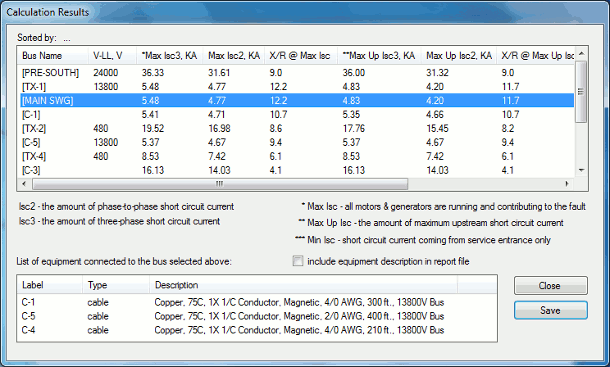
From my experience, motor contribution to faults is typically not significant and can be ignored in arc flash analysis without compromising accuracy of the study. Every rule has an exception though. I would use minimum available short circuit fault current or the amount of short circuit current coming from the utility only (such as indicated in 'Min Isc3, KA' column below) to calculate predicted arcing current and to determine arc duration based on upstream protection device characteristic. I would use maximum available short circuit fault current including contribution from motors ('Max Isc3, KA' column) for the IE and AFB calculations. I would evaluate motor contribution based on the motor subtransient reactance. It is normally 16.7% for induction motors but varies slightly depending on the motor type and size. You may also apply ANSI interrupting duty 1.5 to 4 cycles multipliers (1.5 to 3 times the motor subtransient reactance) to the part of SC contributed by motors. That should provide for the worst case scenario associated with the longest arc duration and the highest current values.
Image

Sample screenshot of Short Circuit Analytic V2.0 software Calculation Results window.

Author:  Jim Phillips (brainfiller) [ Sat Jan 11, 2014 12:17 pm ]
Post subject: 

The current edition of IEEE 1584 (2002) recommends including all motors 50 HP and greater. However there are many variations of this as described in this thread. The 1584 equations do NOT take into account the decay of a source of short circuit current. The only way to handle it now is a piecewise solution - solve for Ei for discrete time periods during the decay. Solving for at least 2 scenarios including no motor contribution and 100 percent motor contribution is a good way to see if the motor contribution will affect the instantaneous tripping of protective devices - and the arc duration.

In a draft text of the next edition, there is some language proposed about the piece wise solution method for cases where the short circuit current may change with time.

Author:  PaulEngr [ Sun Jan 12, 2014 7:36 am ]
Post subject: 

SKM recommends ignoring anything under 50 HP, summing anything 50-250 HP and modelling as one load, and modeling anything bigger individually.

Author:  Giovanni G [ Mon Jan 13, 2014 12:24 am ]
Post subject: 

Thank all.
Jim, do you know some litterature where i can found written on IEEE paper that the current decay are not taken into account by IEEE during arc-flash equation evaluation? (i'm meaning during the creation of these empirical equation, not during arc-flash calculation).

So, i usually do as per your suggestion.
Thanks

Author:  Jim Phillips (brainfiller) [ Tue Jan 14, 2014 4:10 am ]
Post subject: 

The derivation of the equations is discussed in the actual standard from 2002. It was based on measurements of the arc flash incident energy via calorimeters and then the data used to develop the equations. The equations treat the arc flash like a static event i.e. everything is a fixed quantity when one could argue that the event is really dynamic. This is one "hole" that we are hoping to "plug" with revised language. The revised standard will try clarify this by suggesting that for decaying systems (motor contribution, generator decrement, multiple sources tripping at different time intervals) multiple solutions can be used for different time periods.

Most of the software companies already know to do this and may have set up their algorithms accordingly.

Page 1 of 1 All times are UTC - 7 hours
Powered by phpBB © 2000, 2002, 2005, 2007 phpBB Group
http://www.phpbb.com/