Flash wrote:
Did anyone else notice that the 2018 70E removed all clothing recommendations for <= 1.2 cal
Is the NFPA 70E trying to distance itself from 1.2 cal/cm2 threshold incident energy level for a second degree burn first introduced in year 2012? NFPA 70E year 2012 stated that "a second degree burn is possible by an exposure of unprotected skin to an electric arc flash above the incident energy level of 1.2 cal/cm2 ( 5.0 J/cm2 )". The NFPA 70E-2018 Specifically revised the definition of arc flash boundary and no longer uses the term "second degree burn" but instead "at which incident energy equals 1.2 cal/cm2". Although NFPA 70E has informational note referencing the Stoll skin burn injury model, its notion of 1.2 cal/cm2 as some kind of a magic number contradicts the Stoll model. A quote from A.Stoll "Heat Transfer in Biotechnology" summarizes the issue of using a critical thermal load approach in determining arc flash boundary. The quote reads:
"Serious misconceptions have crept into this field of research through adoption of rule-of-thumb terminology which has lost its identity as such and become accepted as fact. A glaring example of this process is the “critical thermal load.” This quantity is defined as the total energy delivered in any given exposure required to produce some given endpoint such as a blister. Mathematically it is the product of the flux and exposure time for a shaped pulse. Implicit in this treatment is the assumption that thermal injury is a function of dosage as in ionizing radiation, so that the process obeys the "law of reciprocity," i.e., that equal injury is produced by equal doses. On the contrary, a very large amount of energy delivered over a greatly extended time produces no injury at all while the same "dose" delivered instantaneously may totally destroy the skin. Conversely, measurements of doses which produce the same damage over even a narrow range of intensities of radiation show that the "law of reciprocity" fails, for the doses are not equal."
Be mindful of the pressure to join the crowd (can't get tired repeating it to myself and kids over and over again
 ). Incident energy alone has no impact on thermal damage and blast pressure. One can expose himself to any arbitrary incident energy and suffer no damage as long as the energy is delivered at slow enough rate. On the other hand, an exposure to only a fraction of 1.2 cal/cm2 may result in incurable burn provided that the energy has been delivered fast enough. Google Evaluation of onset to second degree burn energy in arc flash hazard analysis for more information. There is also a free online resource available capable of determining time to 2nd degree burn and onset to 2nd degree burn energy as a function of heat flux (measured in cal/cm^2/sec)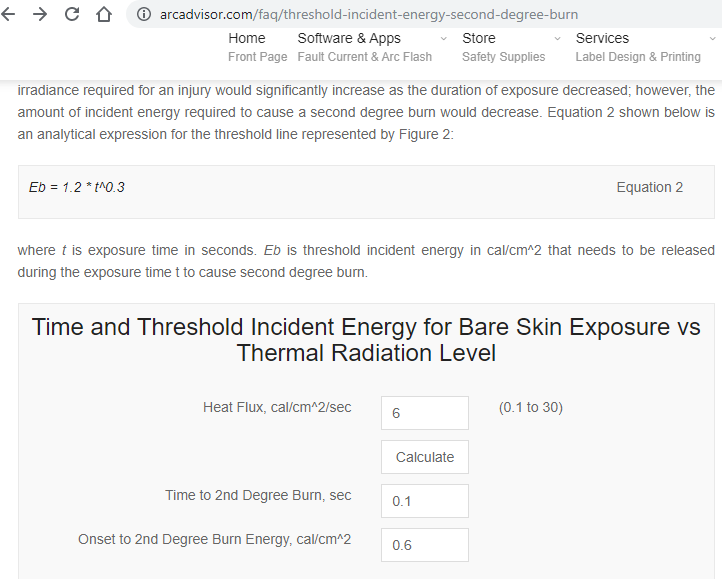
The issue of using incident energy as a measure of damage alone and without regard to the rate of the energy release has been raised to NFPA 70E committee before year 2015 edition was published but unfortunately it was never appropriately addressed by the group.