| Author |
Message |
|
Jim Phillips (brainfiller)
|
Post subject: Arc Flash Labels on Transformers  Posted: Posted: Sun Feb 26, 2017 3:18 pm |
|
| Plasma Level |
 |
Joined: Mon Sep 17, 2007 5:00 pm
Posts: 1738
Location: Scottsdale, Arizona
|
|
This week’s question was prompted by a good discussion last week regarding labeling transformers. A similar question was asked years ago but practices continue to evolve.
This week’s question:
Do you believe transformers should have arc flash labels?
Yes
No
Sometimes – it depends
No opinion
|
|
| Top |
|
 |
|
bbaumer
|
Post subject: Re: Arc Flash Labels on Transformers Posted: Mon Feb 27, 2017 4:36 am |
|
| Arc Level |
 |
Joined: Fri Jul 08, 2016 10:01 am
Posts: 499
|
|
I label oil filled pad mounts as those are easy to open up and sometimes must be opened up for taking oil samples and often have very high incident energy values and large boundaries. See previous discussion on this in a couple different threads.
I do NOT label dry types. Dry types are not typically opened while energized. Although I have done it plenty of times in my younger days before arc flash was such a hot topic, looking back on it, it is really a dumb thing to do. Each time I was nervous about losing control of the cover, was not wearing any PPE (probably didn't even know what PPE was at the time) and in hindsight it was unnecessary. I should have just scheduled an outage and then looked at and/or wired what I needed to with it dead.
Where I work the policy is if it doesn't have a label then shut it down before opening. I work at a university. We have about 100 buildings on campus and do the studies and labeling ourselves.
_________________
Retired but I might visit once in awhile
|
|
| Top |
|
|
|
Reeberas
|
Post subject: Re: Arc Flash Labels on Transformers Posted: Mon Feb 27, 2017 7:07 am |
|
Joined: Mon Apr 06, 2015 9:51 am
Posts: 7
|
|
I feel that they should be labeled as others have mentioned the arc flash hazard is typically the highest point in the system. If the connections are not equipped with an window for doing IR scans, the cover come off and knowing the hazard will hopefully guide people to wearing the correct PPE.
|
|
| Top |
|
|
|
wilhendrix
|
Post subject: Re: Arc Flash Labels on Transformers Posted: Mon Feb 27, 2017 7:19 am |
|
Joined: Tue Jan 19, 2010 2:35 pm
Posts: 175
|
|
Good question Jim. We've had some discussions about this as well and we determined that we would label most transformers, even as small as 15 kva. Why go that low? Because all have voltage hazards and some level of arc flash hazard. It is possible that a person will open up a transformer for some reason and be exposed to both arc flash and shock hazard.
Several years ago, when the 240 volt and 125 kva exception was in place, I wanted some guidance on how to determine when it was acceptable to use that exception. So I asked NFPA about labeling transformers smaller than 125 kva and 240 volts. Here was my question "what do we do, for example, if we have a smaller step down transformer where both the high and low voltage terminals are in close proximity to each other?" They didn't answer, instead they asked "why are you opening energized transformers?" In the end, I just gave up asking them and decided for myself.
To me it comes down to this. If a device has an arc flash and shock hazard label, what's the purpose of the label if not to quantify the hazards? If the label does not do that, how are workers to know the amount of PPE needed to properly protect him or herself as well as those around them?
|
|
| Top |
|
|
|
JBD
|
Post subject: Re: Arc Flash Labels on Transformers Posted: Mon Feb 27, 2017 7:50 am |
|
Joined: Mon Jan 18, 2010 11:35 am
Posts: 616
Location: Wisconsin
|
wilhendrix wrote: ... smaller step down transformer where both the high and low voltage terminals are in close proximity to each other?... Small transformer terminals (e.g. 600V max, <150kVA, dry type, 3-phase) aren't just close to each other, they are actually intermingled. You can not create a secondary L-L-L arcing fault across the terminals without also involving the primary. If we believe that the plasma of an arcing event inside of a panelboard will expand to engulf and thereby effectively nullify the main breaker, then shouldn't we expect a similar plasma event in a transformer? So for small dry type transformers a label warning of the highest voltage and the source side AF Incident Energy might be sufficient. For compartmentalized and larger transformers where the primary and secondary terminals are not intermingled, like those used in unit substations, a secondary arcing fault may not propagate to the primary.
|
|
| Top |
|
|
|
bbaumer
|
Post subject: Re: Arc Flash Labels on Transformers Posted: Mon Feb 27, 2017 7:56 am |
|
| Arc Level |
|
Joined: Fri Jul 08, 2016 10:01 am
Posts: 499
|
For those of you that are saying yes, label them, what are you using for the gap? Brief discussion on it in this thread and others: viewtopic.php?f=4&t=4323There are so many configurations I don't know how you could accurately model them without opening them up and measuring. If you assume a small one-size fits all gap then your calcs probably won't be accurate so what's the point?
_________________
Retired but I might visit once in awhile
|
|
| Top |
|
|
|
RogerF
|
Post subject: Re: Arc Flash Labels on Transformers Posted: Mon Feb 27, 2017 9:42 am |
|
Joined: Mon Nov 23, 2015 9:15 am
Posts: 7
|
|
We do label dry type transformers and oil transformers if they have doors. Even if it may not be necessary to open dry type transformers, people do. Even if deenergized you have to assume that it is energized until proven otherwise. A worker will be exposed to possible shock and arc flash hazards until the electrically safe work condition is verified.
|
|
| Top |
|
|
|
mike01
|
Post subject: Re: Arc Flash Labels on Transformers Posted: Wed Mar 01, 2017 11:08 am |
|
Joined: Mon Nov 05, 2007 10:10 am
Posts: 48
Location: Mid-West
|
|
Ahh good question I have to say in previous studies I have seen locally they all include labels on transformers then I started to questioning the method in the way the IE was calculated when I would see “gap” distances varied from study to study or even on the same study either switchgear, panel, or cable connection, some based on the 208V some on the 480V some indicating the “worst case” between the two calculations digging into this further understanding on how the values change as the variable changes in the IEEE formula….After reading other form responses and talking with some end users, owners and electricians, I have come to the conclusion that they [low voltage dry type transformers] should not be labeled with anything more than the generic label indicating “Warning Arc Flash and Shock Hazard Present When Energized” other than that how to you calculate a value of incident energy and still protect your liability [always have to keep the lawyers in mind] when there is no defined standard to back up you assumptions…Even understating the “gap” for each transformer design from the manufacture this information can be gathered, however as previously forum member stated the primary and secondary terminations are typically intermingled H1, X1, H2, X2, H3, X3, XO in the low voltage dry’s with no physical separation between them so even if you know the “bus gap” if measured or provided by the manufacturer how do you go about calculating the IE? The commercially available software I have seen to date provides you a Primary Node or bus and a secondary Node or bus but dose not accurately reflect the construction of the transformer configuration with both primary and secondary intermingled in a common enclosure. I do agree when dealing with liquid pad mounts with live front they are typically barbered however because of the door construction and how they overlap you typically have to open the low voltage side to get to the primary but at least it is has an internal barrier and you can calculate both side individually, the same with a low voltage substation if you are terminating in the air terminal chamber with remote overcurrent protection then the voltages are physically isolated and a label could be applied.
Either way I think since there is no standard to back up [legally] how one calculates a dry type with intermingled voltage terminations, and varying “bus” gaps based on size and manufacturer I would recommend avoiding the practice unless the owner has written published standard on how they want the equipment labeled. At least with equipment like transfer switches, large contactors, etc. the bus gap can be defined either by field investigation or published data by the manufacture and your voltage is typically limited to one voltage source the low voltage dry type transformer is a another animal…The only question remains as indicated by another member is how to you dress to verify the transformer is de-energized??
|
|
| Top |
|
|
|
bbaumer
|
Post subject: Re: Arc Flash Labels on Transformers Posted: Thu Mar 02, 2017 4:30 am |
|
| Arc Level |
|
Joined: Fri Jul 08, 2016 10:01 am
Posts: 499
|
mike01 wrote: .............The only question remains as indicated by another member is how to you dress to verify the transformer is de-energized?? Check at the panel or disconnect that the transformer is feeding, which should be labeled. Is that exactly the same as checking the X1, X2 etc? No, but if you check the panel before and it is live, then open the primary and check it again and it is dead, well then that's a pretty darn good indicator I'd say. At least enough to make me feel good about taking the transformer cover off and checking it again without much worry at all.
_________________
Retired but I might visit once in awhile
|
|
| Top |
|
|
|
mike01
|
Post subject: Re: Arc Flash Labels on Transformers Posted: Thu Mar 02, 2017 6:21 am |
|
Joined: Mon Nov 05, 2007 10:10 am
Posts: 48
Location: Mid-West
|
|
So then a follow up question for those more involved with the 1584 standard, research and updates, etc. Has IEEE performed or is there any proposed testing in the works to simulate this condition? A box of a specific dimension with both energized 480V& 208V bus bars at a specified distance to see what happens in an attempt to extrapolate the data into a formula similar to the way the current calculations were created, to provide some guidance on the low voltage transformer discussion or is this more of a manufacturing thing by having the manufacturers providing insulated bus bars to individual compartmentalized sections of the transformer essentially isolating LV from HV bus and terminations like a MV Xfmr. That would then utilize a more standardized bus gap arrangement based on the voltage in that compartment alone??
|
|
| Top |
|
|
|
bbaumer
|
Post subject: Re: Arc Flash Labels on Transformers Posted: Thu Mar 02, 2017 7:39 am |
|
| Arc Level |
|
Joined: Fri Jul 08, 2016 10:01 am
Posts: 499
|
Lots of questions for those who voted "YES" , I label them. No answers though. At least not for the dry types. I especially like Mike01's question about how those that are labeling are calculating IE for an arcing fault between H1 and X3 etc.? I'd like to know how to do that too. What about an arcing fault between all the high and low busses? I assume that would be the worst case. Difference in potential all the way around plus most likely a 30 degree phase shift between primary and secondary. You'd have to know how to do that AND know all the gaps. This would be fun. Lots of extra taps too. Maybe the right thing to do is just put a DANGER SHUTDOWN label on them and be done: 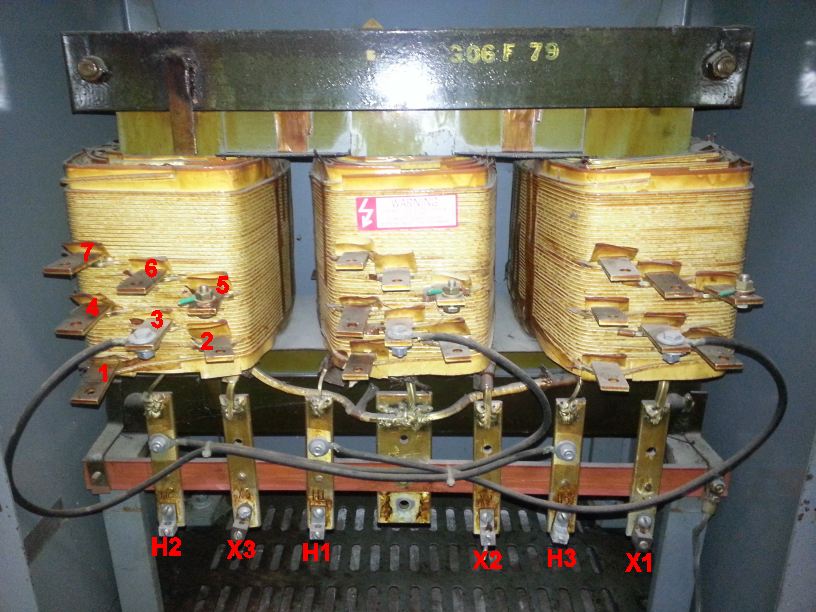
_________________
Retired but I might visit once in awhile
|
|
| Top |
|
|
|
PaulEngr
|
Post subject: Re: Arc Flash Labels on Transformers Posted: Thu Mar 02, 2017 8:12 am |
|
| Plasma Level |
 |
Joined: Tue Oct 26, 2010 9:08 am
Posts: 2178
Location: North Carolina
|
|
The problem from a modelling point of view is two fold.
First off, generally speaking the enclosures are quite large relative to the IEEE 1584 standard enclosure sizes so the exponent for instance is kind of hard to predict.
The second problem is the gap itself. At a grossly overly simplified level, we have a source of heat that is basically shaped like a long cylinder. The amount of heat emitted except at the ends where things get a lot more complicated is essentially linear with the length (current is constant through the arc), giving rise to the fact that arc voltage at DC is fixed, except again for the strange things that happen at the end points. So to some degree we should expect just that...incident energy is linear with gap to a first (and very rough) approximation. The problem is that this is a first approximation. As the arc length gets longer a couple things start happening. The first is that we start to see other arcing phenomena that don't show up on short arcs as per EPRI research on the subject, and the second problem is that the minimum arcing voltage changes the arcing time over each half cycle and might even show a higher arcing impedance (speculation on my part on the latter), leading to weaker arcs after a certain point. This means that not only is the incident energy relationship to arc gap different as the arc length gets larger (6+ inches) but the arc might also be so unstable that we might not get 3 phase arcing or it might self extinguish which renders the calculations pointless. As it stands with the IEEE 1584 equation if you ignore the maximum arc gap requirement, you can easily get nonsense results such as predicting an incident energy higher than the incident energy estimated using the Lee theoretical maximum power transfer assumption.
So for short arcs within the IEEE 1584 empirical range the value can at least be approximated using either the "open panel" or perhaps "open air" model but as the arc gap grows beyond IEEE 1584 empirical relationships, perhaps one of the equations proposed by EPRI or ArcPro might be a better predictor but at this point we're somewhat in uncharted territory.
|
|
| Top |
|
|
|
mike01
|
Post subject: Re: Arc Flash Labels on Transformers Posted: Fri Mar 03, 2017 8:32 am |
|
Joined: Mon Nov 05, 2007 10:10 am
Posts: 48
Location: Mid-West
|
|
So I came across this installation by chance and decided to check for reference, and figured I would share my findings.
| Attachments: |

Xfmr.PNG [ 1.55 MiB | Viewed 18973 times ]
|
|
|
| Top |
|
|
|
bbaumer
|
Post subject: Re: Arc Flash Labels on Transformers Posted: Fri Mar 03, 2017 10:43 am |
|
| Arc Level |
|
Joined: Fri Jul 08, 2016 10:01 am
Posts: 499
|
mike01 wrote: So I came across this installation by chance and decided to check for reference, and figured I would share my findings. That's one out of how many different configurations? I'm going to stick with not labeling them and our "shut it down if it's not labeled" policy. I'd rather do that than put a sticker on it with the wrong data. As mentioned before, a generic DANGER - SHUTDOWN REQUIRED would also work over putting a label on it with arbitrary or erroneous IE and PPE listed.
_________________
Retired but I might visit once in awhile
|
|
| Top |
|
|
 
|
Page 1 of 1
|
[ 14 posts ] |
|
|
You cannot post new topics in this forum
You cannot reply to topics in this forum
You cannot edit your posts in this forum
You cannot delete your posts in this forum
You cannot post attachments in this forum
|
|


