| Author |
Message |
|
Jim Phillips (brainfiller)
|
Post subject: Ever have an electrical fire?  Posted: Posted: Sun Mar 26, 2017 2:59 pm |
|
| Plasma Level |
 |
Joined: Mon Sep 17, 2007 5:00 pm
Posts: 1738
Location: Scottsdale, Arizona
|
|
Have you, your company or client every had an electrical fire? This is wide open to interpretation. Appliances, wiring, equipment etc. including fires big and small.
No
Yes – stories are certainly welcome.
|
|
| Top |
|
 |
|
bbaumer
|
Post subject: Re: Ever have an electrical fire? Posted: Mon Mar 27, 2017 3:15 am |
|
| Arc Level |
 |
Joined: Fri Jul 08, 2016 10:01 am
Posts: 499
|
I saw a heat detector catch on fire during testing once. Does that count? We were doing a new fire alarm system acceptance test. We don't use magnets. We test smokes with smokes and heats with heats etc. We had one of those cup style testing poles over this detector. It was taking an unusually long time to go into alarm. I looked up at the transparent cup and saw a glow inside. Yikes! Attachment:
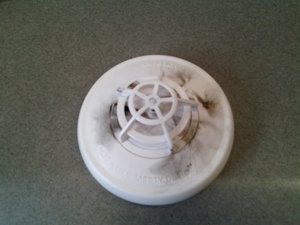 burnt heat detector.jpg [ 385.55 KiB | Viewed 7601 times ]
As far as actual electrical fires go, I did have the furnace (residential ahu with electric heat) in my rental catch on fire. It burned itself out though. My renter, a family member, was not particularly good about paying rent nor good about reporting any issues with the property. My wife saw on Facebook the renter posted they didn't have any heat. They didn't report it to me I assume because they didn't want to hear me say anything about the late rent. In any case, I went over to the house and opened up the furnace. All the wiring inside was burnt to a crisp. They were very lucky it did burn the place down. I don't have pics, sorry.
_________________
Retired but I might visit once in awhile
|
|
| Top |
|
|
|
willcoc
|
Post subject: Re: Ever have an electrical fire? Posted: Mon Mar 27, 2017 5:41 am |
|
Joined: Fri Jul 10, 2009 10:14 am
Posts: 32
Location: West Central, OH
|
|
The facility was trying to do the correct thing with Thermography scans. Except this box could not be worked on unless the utility company removed power to the facility. This feel through the cracks and ~6 month's later, we had an incident. Other than the box and the plywood it was mounted to, no significant building damage.
| Attachments: |
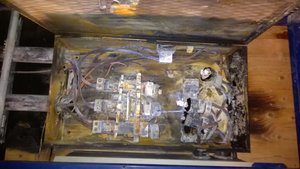
WP_20150902_004.jpg [ 392.59 KiB | Viewed 7592 times ]
|
|
|
| Top |
|
|
|
Larry Stutts
|
Post subject: Re: Ever have an electrical fire? Posted: Mon Mar 27, 2017 6:06 am |
|
| Sparks Level |
 |
Joined: Tue Apr 17, 2012 8:19 am
Posts: 253
Location: Charlotte, NC
|
|
Yes,
The city replaced my meter with a new one that they could read remotely. Shortly thereafter there was a fault in my meter box and it caught my garage on fire which then propagated through the attic of my house. When the firemen arrived they hosed down my neighbors house first, since his siding was melting off his house. They gathered all my furniture in the center of the rooms and covered it with tarps, then hosed down our house. We lost everything in the garage - ironically with the exception of a package of fire starter sticks. I had several items in the garage that my insurance deemed as commercial equipment (A Allen Bradley programming terminal, a Wheatstone/Wein bridge, a small gang-box I used for start ups and an assortment of components like SCRs and Diodes) that they did not cover. We lost almost everything in the attic - one box of Christmas ornaments survived. We ended up taking the house down to the floor joists and rebuilding.
|
|
| Top |
|
|
|
Scott Peterson
|
Post subject: Re: Ever have an electrical fire? Posted: Mon Mar 27, 2017 8:32 am |
|
Joined: Tue Apr 29, 2014 7:43 am
Posts: 18
|
|
I work in a woodworking factory. On two separate occasions I had motors catch fire right as I was standing there. These were open drip proof type motors, and when they failed electrically they shot sparks out of the open vents in the rear of the motor. We keep things pretty clean here, but if they had landed in a pile of dust and no one was standing there, there would have been a fire. Now we ONLY use TEFC motors, which are much less likely to do this.
Another time I was visiting another wood shop when an employee was sweeping next to a large dust collector. He bumped into a piece of flexible armored conduit, which shorted internally made a big flash, and burned a row of holes in the flex conduit. It was not the waterproof plastic sealed type, just metal. This was a 15 hp unit with an 100 amp service. The wires had vibrated for years inside the conduit until the insulation was worn through. Bumping the conduit with the broom caused the wire to short to ground. Amazingly there was no injury or fire, partly due to a clean concrete floor and brick wall nearby.
|
|
| Top |
|
|
|
PaulEngr
|
Post subject: Re: Ever have an electrical fire? Posted: Mon Mar 27, 2017 9:39 am |
|
| Plasma Level |
 |
Joined: Tue Oct 26, 2010 9:08 am
Posts: 2178
Location: North Carolina
|
|
This story is kind of the opposite of an electrical fire...how to eliminate them.
In the past I've been an engineer for plants with some sort of thermal processing (kilns, ovens, etc.). With most of them it's not a matter of "if" but "when" in terms of fire potential. In iron & steel as well as refineries you pretty much always have a fire going somewhere, whether it is intentional or not is another matter. It gets a lot more exciting though when you have a contained fire...also known as an explosion.
So in one of those jobs I was quite literally the last electrical engineer for the first cast iron pipe plant in the country. They had a pipe out front that said "200 year anniversary" on the side of it. About 8 years later for various reasons they closed the plant and tore it down so that nobody will ever make a pipe there again. The plant was just down the street from the Roebling Wire Works, also torn down but famous for producing all the wire and cable to make the Roebling bridge in Cincinnati and more famously for the Brooklyn bridge in NYC. Needless to say there was an incredible amount of history and historical artifacts in that place. There was some equipment there that was probably touched by George Westinghouse himself. Can you say "Igor, throw the switch"?
Twice a year the Factory Mutual guy would come by and do an inspection on us. Every so often he would come up with questions about adding sprinklers here or there around the plant. Mind you this is a place where we always had fires going everywhere. Occasionally when a sand mold broke, the casting machines would sling molten (2400-2600 degrees) iron all over everything. In the melt shop every ladle (about 10,000 lbs.) of molten iron would get a shot of magnesium in it and since magnesium boils at 2050 degrees, it would throw stuff everywhere and "containment" is something of a pipe dream. Burner tiles and refractory would occasionally fail and you'd have a hot spot or outright flames showing in various places at various times. Whenever a vendor came to the plant and it came time to discuss the temperature limits of their product, once I figured out they didn't have a clue then it became my job to engineer some sort of enclosure/housing/construction method to install their device in my environment. I usually just told them to leave the "hardening" to me. We came up with all kinds of ways to do water or air cooling or simple passive heat shields to reduce the temperatures on the various sensors that we used in the plant.
I can go on and on about this but what I can say with a straight face is that they had over 200 years of practice learning how to burn up and destroy anything, whether electrical, hydraulic, steel, rubber, or concrete. So when someone tries to tell you in a plant that has literally tons of refractory brick, castable, and moldables, furnace tape and other applications of mineral wool, never mind the amount of teflons, silicones, and the like...well, you just have to laugh when someone suggests putting in sprinkler systems.
Similarly they went crazy on some excavators and wanted to have fire protection for the electrical equipment on board. There were a lot of impractical problems with doing this but FM doesn't usually concern themselves with that. On an excavator 99% of the fire hazard is because there is a lot of open gearing and thus you always have open gear lube accumulating in various places. The electrical equipment in contrast is relatively harmless.
|
|
| Top |
|
|
|
wilhendrix
|
Post subject: Re: Ever have an electrical fire? Posted: Wed Apr 12, 2017 9:26 am |
|
Joined: Tue Jan 19, 2010 2:35 pm
Posts: 175
|
|
Does an older 480 volt 3000 amp MCC and distribution count? If so, then my answer is yes.
In the late 70's I was a brand new service electrician, that meant working alone for commercial and industrial customers. It was late Friday afternoon in the middle of summer in Phoenix. I got paged (no cell phones then) to go to a tannery. The tannery was 50 miles away from where I was. I got there as fast as I could because the client said, "the power is off and we have a hundred thousand dollars of hides that are rotting!" I arrived and found they had a utility but the client had shut off their 3000 amp fused main. BTW, no GFI at this time.
Its a long story but the nutshell version is this. The gear had not been cleaned in years and there was a high resistance phase to phase fault of the main buss. My very new digital VOM was not the right meter to check for high resistance faults, but it was what I had. The shop had one Megger and it was not available. I shut off all the fused disconnects in this Square D MCC and checked for any short in the buss. I found nothing wrong and decided to energize the main. That's when the high resistance fault became an arcing fault. The gear blew out fire and smoke for a minute, then the power company fuses tripped. BTW, the 3000 amp fuses never tripped.
What caused the fault? Here's what probably happened. The gear was made before it was common practice to plate the copper buss. This bare copper buss was exposed to the chemicals the tannery used to "unhair" the hides. The copper was attacked by the chemical and over the years, the copper flaked off. Instead of falling harmlessly on the concrete slab, it fell onto spider webs in the gear. The web was strong enough to hold the copper and it created a high resistance path between phases. I made several mistakes, but chiefly, I allowed this emergency to override my good judgement. I could have driven back to Phoenix and gotten the Megger., I could have been much more careful about trying to see inside the gear. I could have even substituted a smaller fuse in the disconnect. But I did none of those things. Lucky, no one was injured, only equipment damage and loss of production.
So, what's to be learned from my mistakes? Mainly that you not let an emergency override you judgement and ignore safe work practices. Behave like the professional you are. The time taken to think through your next moves might be more than worth it. Particularly if it prevents any injury.
Even though it's 40+ years later, I'm still embarrassed by my mistakes. Learning from others errors is just good sense. Please learn from my foolish errors.
|
|
| Top |
|
|
 
|
Page 1 of 1
|
[ 7 posts ] |
|
|
You cannot post new topics in this forum
You cannot reply to topics in this forum
You cannot edit your posts in this forum
You cannot delete your posts in this forum
You cannot post attachments in this forum
|
|


