Technical Articles

2024 NFPA 70E

FREE Download Arc Flash Hazard Calculation Guide

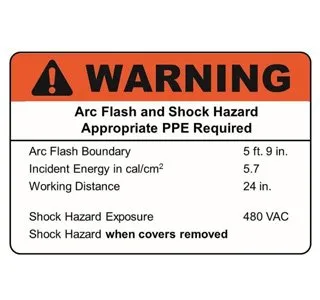
The 2017 NEC and Arc Flash

By Jim Phillips The 2017 National Electrical Code (NEC) contains several changes regarding arc flash: Download FREE Arc Flash Calculations 110.16(B) Arc-Flash Hazard Warning of Service Equipment 240.87 Arc Energy Reduction (Circuit Breakers) 240.67 Arc Energy Reduction (Fuses) The severity…
Read More »
Arc Flash Labeling Requirments

Arc Flash Labels and ANSI Z535

If you ask five different people what an arc flash label should look like, you will likely receive five different answers. Although there are no hard and fast rules regarding the label format, there are some minimal requirements found in…

Read More »
FREE Download Arc Flash Hazard Calculation Guide

Utility Short Circuit Data – Different Formats

Utility Short Circuit Data – Different Formats: National Electrical Code 110.9 Interrupting Ratings states that: Equipment intended to interrupt current at fault levels shall have an interrupting rating at nominal circuit voltage at least equal to the current that is available at the line terminals of the…

Read More »
2018 NFPA 70E electrical safety training video by Jim Phillips, P.E.

2018 NFPA 70E Update – What’s New? What’s Changed?

2018 NFPA 70E Update – What’s New? What’s Changed?: Published: June 2017 By Jim Phillips Based on Jim’s article originally published in the May 2017 Issue of Electrical Contractor Magazine . It is hard to imagine that three years have passed since I wrote the 2015 NFPA 70E update…

Read More »
Question mark illustration

Arc Flash Study Top 10 FAQs Part #3

How Does Everyone Else Do This? By Jim Phillips 3-Part Series ARC FLASH LABELS What do you list on an arc flash label when the prospective incident energy is greater than 40 cal/cm 2 ? This question is a variation…

Read More »
Question mark illustration

Arc Flash Study Top 10 FAQs Part #2

Arc Flash Study Top 10 FAQs Part #2: How Does Everyone Else Do This? By Jim Phillips 3-Part Series ELECTRICAL SAFETY PRACTICES Does your company or client permit energized work where the incident energy is greater than 40 calories per centimeter squared (cal/cm2)? This question is about the…

Read More »
Question mark illustration

Arc Flash Study Top 10 FAQs Part #1

How Does Everyone Else Do This? By Jim Phillips 3-Part Series There are many frequently asked questions about performing an arc flash study (risk assessment) and understanding electrical safety requirements. A careful read of standards such as NPFA 70E or…

Read More »
Yellow electrical safety training warning sign

Electrical Safety Training: It Will Save Your Life!

By Jim Phillips Performing electrical work without being properly trained can be deadly. I have seen this hold true during numerous investigations. Many companies proactively provide employee training and refresher courses at least every 3-years. Some companies use shorter intervals…

Read More »
Orange and gray Brainfiller symbol

Evaluation of Onset to Second Degree Burn Energy in Arc Flash

Our interest in determining accurate onset to second degree burn energy and its significance in computing the arc flash boundary is focused on the prevention of injury to the skin of a human who might be exposed to an arc-flash. During the last two decades different formulas have been proposed to calculate incident energy at an assumed working distance, and the arc flash boundary in order to determine arc rated personal protective equipment for Qualified Electrical Workers. Among others, the

Read More »
Orange and gray Brainfiller symbol

Include Date on Arc Flash Label?

According to the 2015 Edition of NFPA 70E 130.5(2), The arc flash risk assessment “…shall be reviewed periodically, at intervals not to exceed 5 years, to account for changes in the electrical distribution system that could affect the results of the arc flash risk assessment.” According to 130.5(D) Equipment Labeling, the date is not listed as a requirement for including on the label. However, many believe the date is an important aspect of the label in order to keep track

Read More »