English
 Spanish

NFPA 70E may be an American standard, but its influence extends far beyond the United States. And Australia is a great example.
Many people associate NFPA 70E, Standard for Electrical Safety in the Workplace, strictly with the United States. After all, the National Fire Protection Association (NFPA) is a U.S.-based organization, and the NFPA 70E Technical Committee, of which I am a member, consists primarily of members from the U.S., along with representation from Canada.
However, electrical hazards don’t recognize international borders. Neither should our efforts to protect people from them.
An Interesting Example from Australia
My first business visit to Australia was back in 2012. At the time, I noticed considerable differences in how electrical safety and arc-flash hazards were being addressed compared with practices in the United States.
Over the years, I’ve had the opportunity to return many times, speaking at conferences, conducting workshops, and contributing articles to Australian industry publications, including Industrial Electrix.
Watching the growing interest in electrical safety over those years has been especially rewarding.
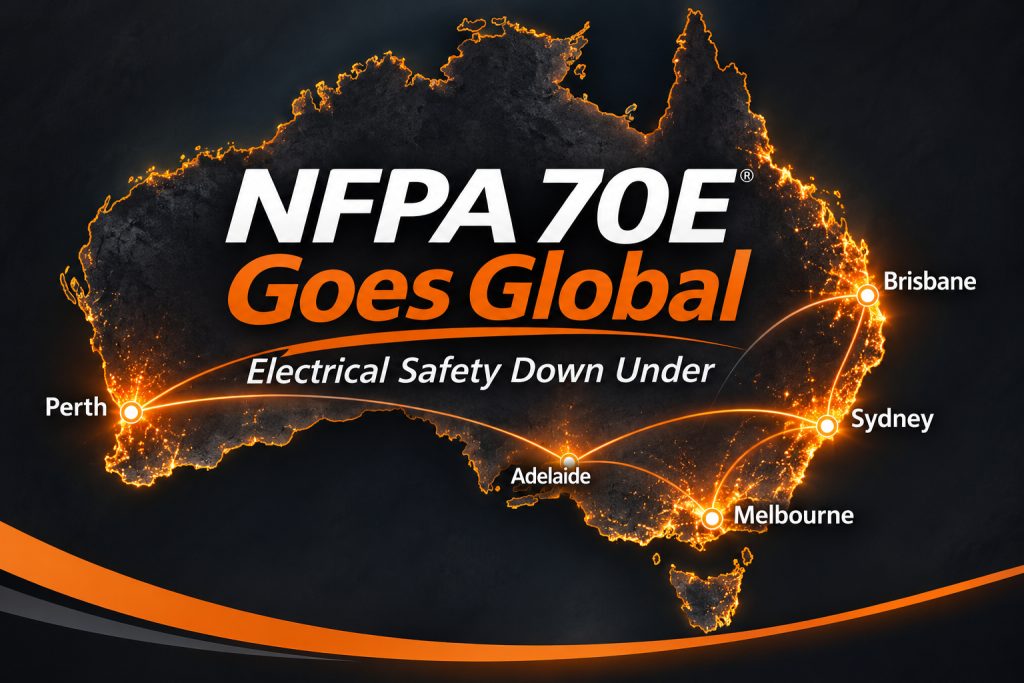
During my most recent visit, I had the opportunity to present at conferences and conduct arc-flash and IEEE 1584 workshops in Brisbane and Perth. One of my international keynote topics was the 2027 Edition of NFPA 70E.
What struck me was the tremendous interest in NFPA 70E and its latest developments. The questions, discussions, and exchanges of ideas reinforced something I’ve observed throughout my international travels: electrical safety professionals around the world are interested in learning from the same research, experiences, and evolving safety practices.
And the interest wasn’t limited to arc-flash calculations. The broader discussions about electrical safety, risk assessment, work practices, and protecting employees were equally important.
It’s encouraging to see how electrical safety knowledge continues to evolve and cross international borders.
An Australian Guideline with an American Connection
The Australian Energy Council published an excellent document titled Electrical Arc Flash Hazard Management Guideline. It provides guidance for managing arc-flash hazards within the Australian energy industry, addressing subjects such as risk assessment, incident energy, protective equipment, labeling, human factors, and safe work practices.
Here’s something that caught my attention when reviewing the document.
NFPA 70E is referenced eight times, and IEEE 1584 is referenced 25 times!
That’s quite a bit of attention for two documents developed in the United States.
Why are these documents so relevant internationally?
Because the underlying science doesn’t change when you cross an ocean. An arc flash in Australia involves the same fundamental electrical and thermal phenomena as one in the United States, Europe, Asia, or anywhere else.
IEEE 1584 provides methods for calculating prospective arc-flash incident energy and the arc-flash boundary. NFPA 70E addresses the broader picture of electrical safety in the workplace, including risk assessments, establishing an electrically safe work condition, safe work practices, and personal protective equipment.
The two documents serve different purposes, but they complement each other.
International Standards and Practices: Learning from Each Other
Electrical safety practices continue to evolve around the world, and one of the most encouraging developments is the increasing exchange of technical information and practical experience across international borders.
NFPA 70E is one of several important resources that electrical safety professionals can draw upon. Along with IEEE 1584 and other national and international standards, it contributes to a broader understanding of electrical hazards and the methods available to manage them.
And this exchange of information works in both directions.
Through my involvement with U.S. and international standards organizations, including IEEE, NFPA, and IEC, I’ve seen firsthand how research, practical experience, and lessons learned in one part of the world can influence electrical safety practices elsewhere.
No single country has all the answers, and we all have something to learn from each other.
Regardless of where a person works, the goal remains the same: identify the hazards, assess the risks, implement appropriate protective measures, and make sure everyone goes home safely at the end of the day.
The Bottom Line
NFPA 70E may have originated in the United States, but many of the principles it addresses are universal.
Whether I’m presenting in Australia, Europe, Asia, or back home in the United States, the conversations frequently return to the same fundamental objective.
Reducing electrical hazards and protecting the people who work around them.
After more than four decades in the electrical industry, that remains the most important part of what we do.
Electrical safety is not an American issue.
It’s a global responsibility.
Developed by the National Fire Protection Association (NFPA), NFPA 70E provides the foundation for electrical safety programs across industries. It outlines safe work practices that protect employees from:
As NFPA 70E has grown and evolved, Jim Phillips has been part of the conversation—helping professionals understand not only what changed, but why those changes matter.
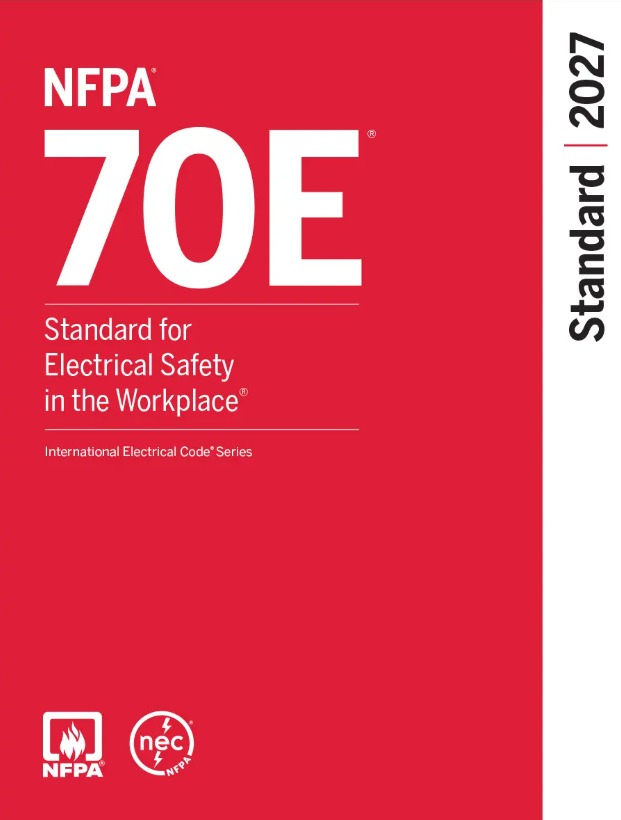
Jim’s expertise comes from the intersection of regulatory insight, standards involvement, and real power-system experience. He doesn’t read from a script—he teaches the reasoning behind every requirement and how it applies in the field.
His training connects NFPA 70E, IEEE 1584, and actual plant conditions, helping organizations align their safety culture, risk assessments, and maintenance programs.
With a career beginning in 1981 and Brainfiller launching in 1987, Jim has built a global reputation as a trusted leader in electrical safety.
He currently:
💡 Did you know? Many NFPA 70E trainers learn the material by attending Jim’s classes—while Jim is involved directly with the standards they teach.


Jim’s background spans:
This progression gives Jim a rare, 360-degree view of electrical hazards—from theoretical models to real-world failures. His training incorporates both the engineering and the practical side of electrical safety.
As Vice-Chair of IEEE 1584, Jim has played a major role in shaping the methodology behind modern arc-flash hazard calculations—the backbone of NFPA 70E’s incident energy analysis and PPE selection.
His instruction includes:

In the early 2010s, NFPA 70E began shifting from a hazard-based approach to a risk-based methodology. Jim contributed to this evolution through published research and committee discussions. His early collaboration with a UK colleague helped introduce the risk-focused thinking now central to each new edition.
He continues to evaluate public input, technical proposals, and revisions each cycle—bringing real-world insight to the standard.
Engineers and electricians consistently give Jim five-star reviews for:
Many participants remark that Jim is the first person who has ever truly explained why a requirement exists—not just what it says.
⭐ Why choose Jim? When you train with Jim Phillips, you’re learning NFPA 70E from someone involved in shaping its direction—not from recycled slides.
All training is available live, on-site, or on-demand, and includes completion certificates with CEU/PDH documentation.NFPA 70E Qualified Worker Training (8 hours)
Covers risk assessment, PPE, LOTO, establishing an electrically safe work condition, and auditing requirements.How to Perform an Arc-Flash Study | IEEE 1584 (16 hours)
Modeling, arcing current, incident energy, arc-flash boundaries, and system-level mitigation.Fundamentals of Electrical Safety (2 hours)
Shock hazards, arc-flash basics, and the building blocks behind NFPA 70E.DC Electrical Safety Fundamentals (2 hours)
Key safety practices for data centers and DC systems.
Organizations that adopt Jim’s training consistently report:
Recent recognition includes:


Because Jim is embedded in NFPA, IEEE, IEC, and NEC committees, he sees emerging trends before they appear in the codebook.
His training materials are updated immediately after each standards cycle, keeping teams aligned with NFPA 70E, IEEE 1584, and OSHA expectations.
🔧 From code to craft: Jim explains why requirements exist and how to apply them correctly in real electrical systems.
Partnering with Jim Phillips ensures your team learns NFPA 70E and arc-flash safety from someone who has helped guide the direction of the standard—not from copied material.
Train with Jim Phillips through Brainfiller.
Empower your team, strengthen compliance, and protect lives with industry-leading NFPA 70E and arc-flash training.

| Cookie | Duration | Description |
|---|---|---|
| cookielawinfo-checbox-analytics | 11 months | This cookie is set by GDPR Cookie Consent plugin. The cookie is used to store the user consent for the cookies in the category "Analytics". |
| cookielawinfo-checbox-functional | 11 months | The cookie is set by GDPR cookie consent to record the user consent for the cookies in the category "Functional". |
| cookielawinfo-checbox-others | 11 months | This cookie is set by GDPR Cookie Consent plugin. The cookie is used to store the user consent for the cookies in the category "Other. |
| cookielawinfo-checkbox-necessary | 11 months | This cookie is set by GDPR Cookie Consent plugin. The cookies is used to store the user consent for the cookies in the category "Necessary". |
| cookielawinfo-checkbox-performance | 11 months | This cookie is set by GDPR Cookie Consent plugin. The cookie is used to store the user consent for the cookies in the category "Performance". |
| viewed_cookie_policy | 11 months | The cookie is set by the GDPR Cookie Consent plugin and is used to store whether or not user has consented to the use of cookies. It does not store any personal data. |