Question: I have a switchboard with horizontal bus. Should I use the HCB model?
Short answer: Not necessarily.
Wait! What? Horizontal might not be horizontal?
NFPA 70E requires performing an arc flash risk assessment which usually means using IEEE 1584 equations via software to conduct an arc flash study. This requires the selection of what is known as the equipment electrode configuration. One of the most misunderstood configurations is HCB.
Let’s clear up a common misunderstanding.
HCB stands for Horizontal Conductors in a Box (or enclosure). HOA stands for Horizontal Conductors in Open Air.
These terms were introduced in the 2018 edition of IEEE 1584 as part of the five electrode configurations used in arc-flash modeling:
VCB – Vertical Conductors in a Box
VCBB – Vertical Conductors in a Box (barrier)
HCB – Horizontal Conductors in a Box
HOA – Horizontal Conductors in Open Air
VOA – Vertical Conductors in Open Air
The confusion usually starts with the word “horizontal.”
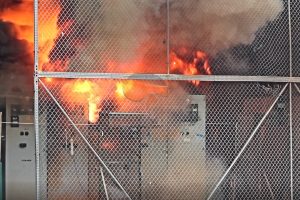
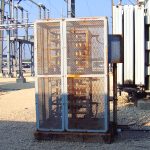
Figure 1 - Not HCB
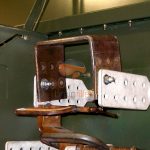
Figure 2 - HCB
Horizontal Does Not Automatically Mean HCB
Just because a piece of bus runs horizontally (left-to-right) as in Figure 1 does not mean you should select HCB.
HCB is very specific.
It applies when:
The conductors are horizontal and
The ends of the conductors are pointed toward the worker
A classic example is stabs in a motor control center (MCC) of a pad mounted transformer as shown in Figure 2. In that case, the horizontal conductors terminate in a way that effectively “aims” the arc plasma outward toward the worker.
That geometry matters — a lot.
Why Geometry Is So Important
In an arc flash event, the arc plasma expands away from the source. The electrode orientation influences how that energy is directed.
With HCB, because the conductors are horizontal and their ends are facing outward, the arc tends to be projected more directly out of the enclosure opening. The result:
More aggressive energy ejection
Higher incident energy at the working distance
Often more conservative (higher) PPE requirements
This is very different from:
A bus running horizontally across the back of a switchboard
A typical left-to-right horizontal bus stack
In those cases, you might actually be dealing with VCB, depending on how the arc would develop and where the conductors are oriented relative to the worker.
Practical Takeaway
Don’t select HCB just because you see horizontal bus.
Ask yourself:
Are the conductors horizontal?
Are the ends of those conductors pointed toward the worker?
Would the arc plasma be projected outward in that direction?
If the answer to #2 is no, it’s probably not HCB.
Always base the electrode configuration on arc behavior and physical geometry, not just the direction the bus happens to run.
That small modeling choice can significantly change calculated incident energy — and ultimately the PPE selection.
About Jim Phillips
With a career beginning in 1981 and Brainfiller launching in 1987, Jim has built a global reputation as a trusted leader in electrical safety.
He currently:
Serves on multiple electrical safety and standards committees, including NFPA 70E, IEEE 1584, IEC TC78, and the National Electrical Code (CMP-4).
Has authored over 100 technical articles and has been a Contributing Editor for Electrical Contractor Magazine (NECA) since 2009.
Holds leadership positions in international working groups that shape arc flash, live working, and risk assessment standards.
Has delivered keynotes and workshops in 20+ countries for engineers, utilities, and industrial organizations.
💡 Did you know? Many NFPA 70E trainers learn the material by attending Jim’s classes—while Jim is involved directly with the standards they teach.
NFPA 70E Training Courses Available Through Brainfiller
Brainfiller offers several courses designed and taught by Jim, all targeted to engineers, electricians, and safety professionals.
Key safety practices for data centers and DC systems.
All training is available live, on-site, or on-demand, and includes completion certificates with CEU/PDH documentation.
How Jim Stays Ahead of Developing Safety Trends
Because Jim is in the leadership position of many codes and standards such as NFPA 70E, IEEE 1584, IEC Live Working, and NEC committees, he sees emerging trends before they appear in the standards.
His training materials are updated immediately after each standards cycle, keeping teams aligned with NFPA 70E, IEEE 1584, and OSHA expectations.
🔧 From code to craft: Jim explains why requirements exist and how to apply them correctly in real electrical systems.
We use cookies on our website to give you the most relevant experience by remembering your preferences and repeat visits. By clicking “Accept”, you consent to the use of ALL the cookies.
This website uses cookies to improve your experience while you navigate through the website. Out of these, the cookies that are categorized as necessary are stored on your browser as they are essential for the working of basic functionalities of the website. We also use third-party cookies that help us analyze and understand how you use this website. These cookies will be stored in your browser only with your consent. You also have the option to opt-out of these cookies. But opting out of some of these cookies may affect your browsing experience.
Necessary cookies are absolutely essential for the website to function properly. These cookies ensure basic functionalities and security features of the website, anonymously.
Cookie
Duration
Description
cookielawinfo-checbox-analytics
11 months
This cookie is set by GDPR Cookie Consent plugin. The cookie is used to store the user consent for the cookies in the category "Analytics".
cookielawinfo-checbox-functional
11 months
The cookie is set by GDPR cookie consent to record the user consent for the cookies in the category "Functional".
cookielawinfo-checbox-others
11 months
This cookie is set by GDPR Cookie Consent plugin. The cookie is used to store the user consent for the cookies in the category "Other.
cookielawinfo-checkbox-necessary
11 months
This cookie is set by GDPR Cookie Consent plugin. The cookies is used to store the user consent for the cookies in the category "Necessary".
cookielawinfo-checkbox-performance
11 months
This cookie is set by GDPR Cookie Consent plugin. The cookie is used to store the user consent for the cookies in the category "Performance".
viewed_cookie_policy
11 months
The cookie is set by the GDPR Cookie Consent plugin and is used to store whether or not user has consented to the use of cookies. It does not store any personal data.
Functional cookies help to perform certain functionalities like sharing the content of the website on social media platforms, collect feedbacks, and other third-party features.
Performance cookies are used to understand and analyze the key performance indexes of the website which helps in delivering a better user experience for the visitors.
Analytical cookies are used to understand how visitors interact with the website. These cookies help provide information on metrics the number of visitors, bounce rate, traffic source, etc.
Advertisement cookies are used to provide visitors with relevant ads and marketing campaigns. These cookies track visitors across websites and collect information to provide customized ads.
 English
  Spanish