Technical Articles

electrical safety

Face equipment or face away during switching?

Weekly Question: This week’s question was submitted from one of our forum members. I will post it here When locking out or resetting a tripped breaker on a CAT 4 system (actually extreme danger), I have one electrician that says he feels more comfortable facing the distribution than facing away. He argues that the shield will protect him better than the Balaclava. He also says that the force needed to reset a tripped (1200 Amp) breaker is easier when facing

Read More »

Hot Stick Testing

Question: Everyone, I got this question from a client. He asked if it’s necessary to have their hot sticks tested? Understand this company has nothing higher than 480 volts on site and only uses these hot sticks to switch on and off 480 volt 30- to 200 amp bus duct fused disconnect switches. The bus in this factory is hanging well above the floor. If an employee needs to reach a bus plug, he uses a hot stick to access

Read More »

How far would you go?

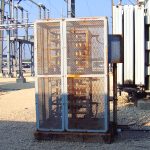
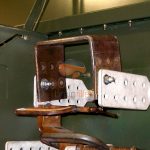
All – I found this installation the other day while in an area I am not officially in charge of. I called the person in charge and recommended he have it removed form service that day before something bad happened. Obviously that didn’t happen. If your electrician installed this would he still be working for you? How about his supervisor who did not have it removed? The other option would be I’m the crazy one and it’s no big deal.

Read More »

Short sleeves versus long sleeves

The industrial plant I work in has a policy that you must have long sleeves when inside an electrical room. Yesterday we had our annual “cold day”, where all turbine generators are offline and we are disconnected from the electric utility. During that period it is common practice for electricians to where short sleeves only. However, there doesn’t appear to be a facility policy to that effect, so someone made a fuss and we are having to clarify the policy.

Read More »

X factor for Disconnect switches

Hello What is the optimal X factor for disconnect switches. I assumed it is 2 because that’s the default value that ETAP gives you. Am I correct for assuming this? Furthermore, It falls under the low voltage category (0.208-1), so it can be the value for MCC’s and panels which is 1.473. Which value is optimal for Arc Flash calculations? Thanks READ MORE

Read More »

PPE Selection when Interacting with non-labeled Equipment

Hi All, To put my question in context, I train Industrial Maintenance and Construction Electricians at a Community College. Some of the students are new to the field and are receiving training to gain employment. Many of the students are already employed and are taking classes to enhance their skill set. Many of these folks are involved with service work that takes them to a variety of locations from 7-11s to industrial sites. Where I am troubled is how to

Read More »

Arc Flash Training – Keeping Skills Current in a Down Economy

Electrical Power Training and Arc Flash Training remain even more important in a down economy. What if you had been stranded on a deserted island for the past five years? By the time you were rescued, you would have missed the explosion of social media usage, including Facebook, YouTube and Twitter, as well as advancements in smart grids and wind and solar energy—it would be more than you could imagine. You may think, “How could the industry have changed so

Read More »

U.K. Article – Arc Flash – Not Just an Electrocution Hazard – Part 3

Arc Flash – The need for risk assessment is embodied in European Law through directive 89/391 and is transposed into UK Law through Management of Health and Safety at Work Regulations. Most people are familiar with the general principles of prevention as laid down in these documents and in other UK regulations. They say that “Where an employer implements any preventative measures, he shall do so on the basis of the principles of prevention” shown below. The authors discuss how

Read More »

How Did We Get Here? The History of Electrical Safety

It seems like the more you attempt to learn about arc flash and electrical safety, the more confusing it becomes. A mixture of letters such as OSHA, NFPA 70E, NEC, IEEE 1584, ASTM F1506 seem to be the secret language used by the electrical safety industry. Who created this alphabet soup of standards, and how did we get here?

Read More »