English
  Spanish

Fifteen years ago on March 11, 2011, a devastating earthquake struck Japan with a magnitude of 9.0. Little did I know at the time that I would become part of the international investigation team.
Most people remember two things: the devastating tsunami and the disaster at the Fukushima Daiichi nuclear power plant. But there was another event that almost no one talks about—an arc flash at a different nuclear power plant. The Onagawa Nuclear Power Plant. Wait… what?
The massive earthquake caused violent ground motion across northeastern Japan. The Onagawa Nuclear Power Plant, was actually the closest nuclear facility to the earthquake’s epicenter. Despite the extreme shaking, the plant’s structural systems performed remarkably well. But something unusual happened inside.
During the earthquake, a fire broke out in a 6.9 kV switchgear lineup at Unit 1.
A fire? Inside a nuclear plant? During an earthquake? Naturally, people wanted answers.
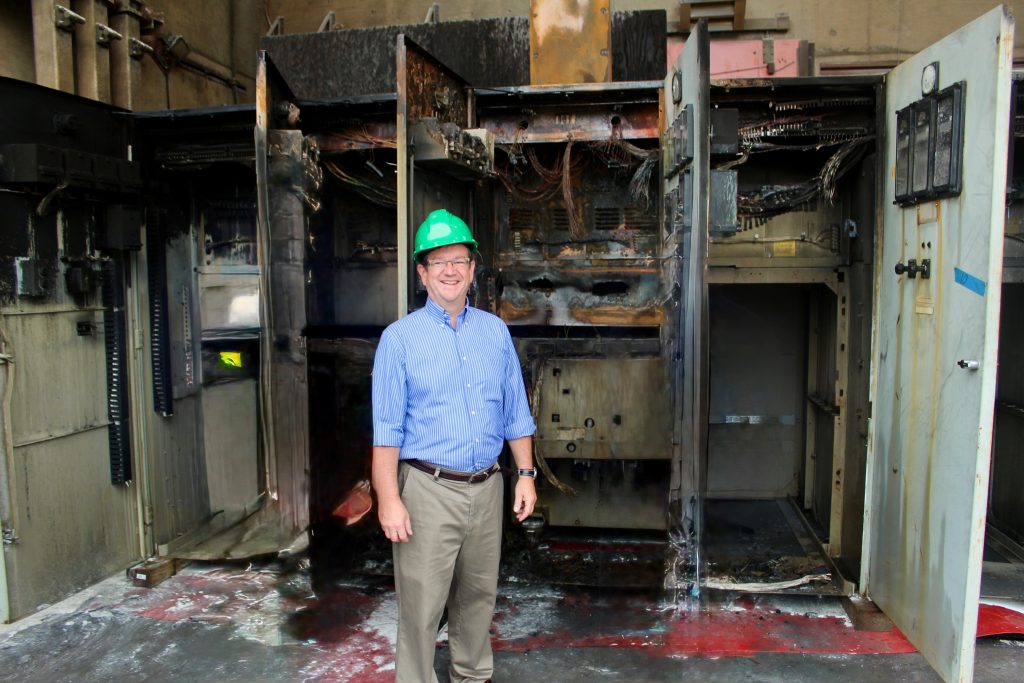
The Japanese government assembled an international team to investigate what happened. Experts from Japan Nuclear Energy Safety Organization (JNES), the U.S. Nuclear Regulatory Commission (NRC), Southwest Fire Research Institute, as well as a few other international organizations, …and me. As it turned out, I was the only one from the delegation that had a background in arc flash.
Together, the goal was to determine the answer to the puzzling question:
How can an earthquake start a fire inside nuclear power plant?
One of the early meetings was held just outside Philadelphia. The Japanese delegation walked us through the sequence of events at Onagawa. They had photos, timelines, equipment damage reports. People began floating all kinds of theories about how the fire started but honestly, none of the explanations I was hearing made much sense from an electrical standpoint.
Then one slide popped up during the presentation. It was a photo of the damaged switchgear bus bars. They were seriously distorted.
And at that moment… Ding ding ding. I think I just figured it out from only one photo.
I asked a simple question: “How did the bus bars become deformed?” The assumption in the room was that the intense heat from the fire warped them. OK, here comes my follow-up question: “If heat caused the deformation… how did the top bus bar bend upward?”
Silence – No one knew.
So I opened my laptop and pulled up a high-speed arc flash video showing bus bars during a high-current fault. When massive short-circuit current flows through parallel conductors, the magnetic forces can be enormous. The Lorentz forces between conductors can cause bus bars to bend, distort, and repel each other.
So I now floated my theory.
A magnitude 9.0 earthquake is hard to comprehend – I can not even imagine. The ground doesn’t just shake—it violently accelerates structures in multiple directions.
So what if the seismic motion caused something inside the switchgear to shift and bus bars to flex?
What if:
That arc flash could release enormous energy—heat, vaporized metal, pressure waves, and molten particles. In nuclear safety terminology, this type of event is called a High Energy Arcing Fault (HEAF).
Someone in the room then asked me: “What is an arc flash?” So I ended up giving an impromptu arc flash tutorial to an international nuclear investigation team. Not something I expected when I woke up that morning. But after a long discussion, the group agreed: This was a plausible mechanism – and we needed to explore it further.
A full-scale test program was developed to see whether an arc flash could produce the kind of sustained fire observed at Onagawa. While traditional arc flash testing focuses on things like: Incident energy and Arcing current, the nuclear industry had a different concern. They wanted to understand the Zone of Influence (ZOI)—how far the effects of a high-energy arcing fault could spread beyond the equipment enclosure.
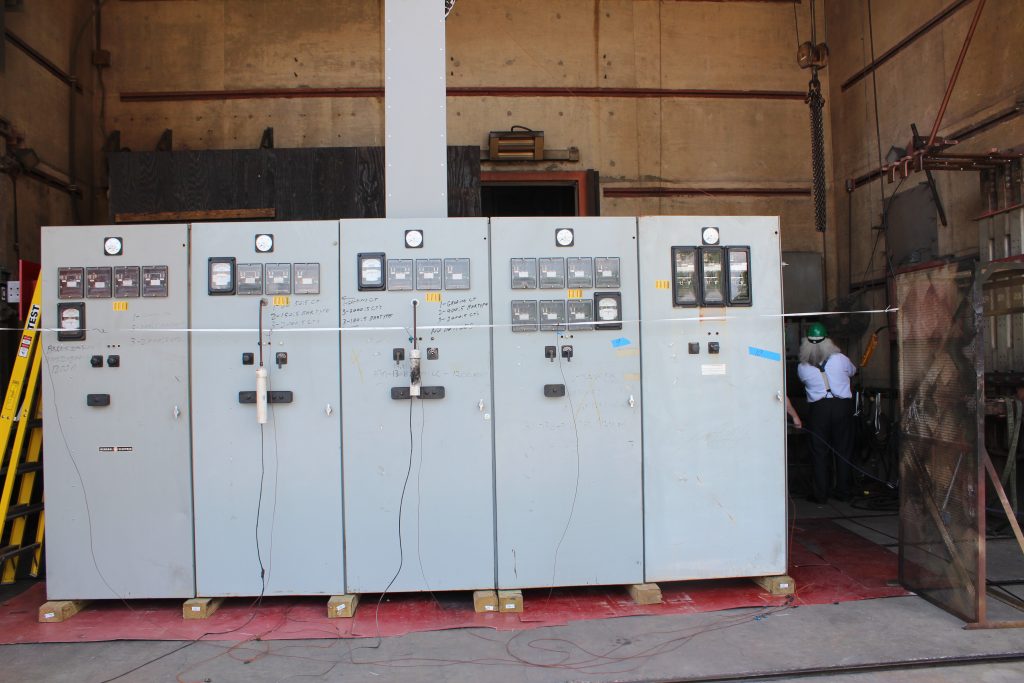
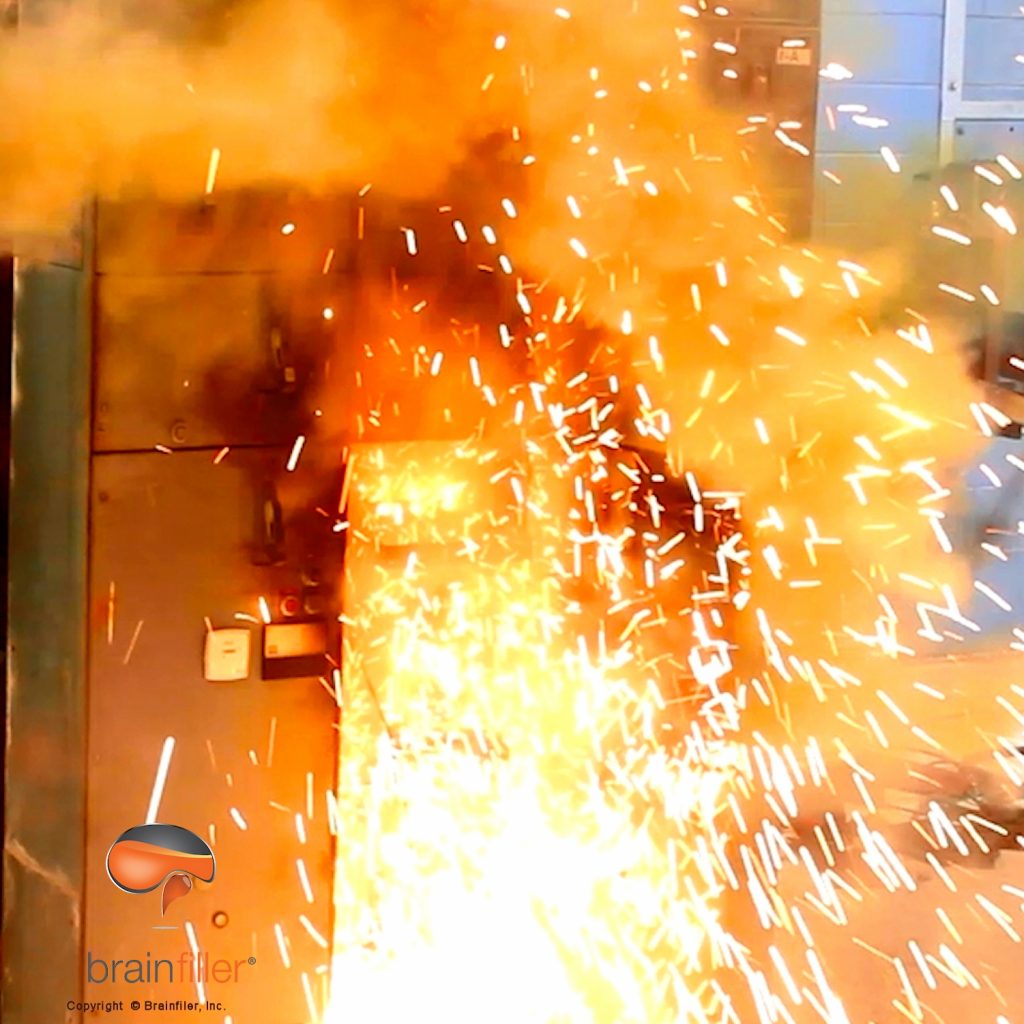
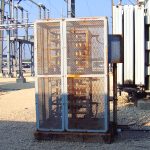
I’ve been involved in a lot of arc flash tests over the years. Some were very impressive, but not as impressive as what was about to unfold with these tests. The most dramatic one I was ever responsible for was about to occur and involved 15 kV switchgear operating around 7 kV – very similar to what existed at the Onagawa plant.
The objective was simple: Can an arc flash ignite insulation and create a sustained fire?
We had three days. Each day followed the same routine:
Then during the last hour…
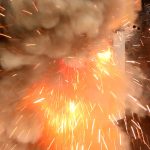
Three – Two – One – KA-BOOM!
Day 1 On the first day, we got a spectacular arc flash complete with a huge plasma, molten metal, blast pressure, a fire and major damage. But the fire didn’t sustain. Exciting and disappointing all rolled into one.
That night I went back and studied the video footage as a postmortem. Why no sustaining fire? We decided to tweak the trigger wire configuration and arc duration to increase the energy release.
Day 2 The next test was even more spectacular. The arc ignited, the plasma and thermal energy blasted out of the gear, and for a moment everything went quiet.
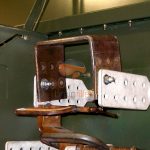
Then I noticed a little flicker behind a hole where there used to be a pistol grip:
“Wait… is that a fire?” I exclaimed?
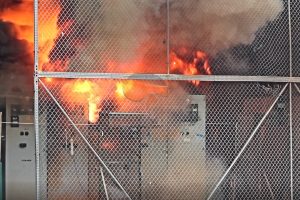
Yes, A small flame appeared. Then it grew. And grew. AND GREW! It became quite an inferno. The switchgear was sitting a few inches off of the ground and the wire way shown in the photo, was packed with cables that caught fire. We had the perfect chimney effect. Air entering from the bottom and the wireway acting as a flame thrower towards the ceiling!
Then someone from the delegation turned to me and asked: “Mr. Phillips… how do we extinguish this fire?”
For a split second I panicked. Then I realized something. I had been brought in to create the arc flash and sustained fire, not to figure out how to put it out. So my response: I have no idea!
Be careful what you ask for.
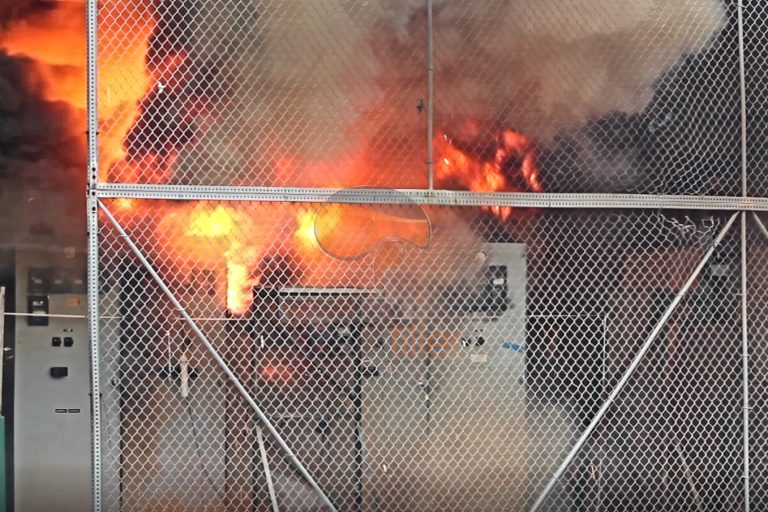
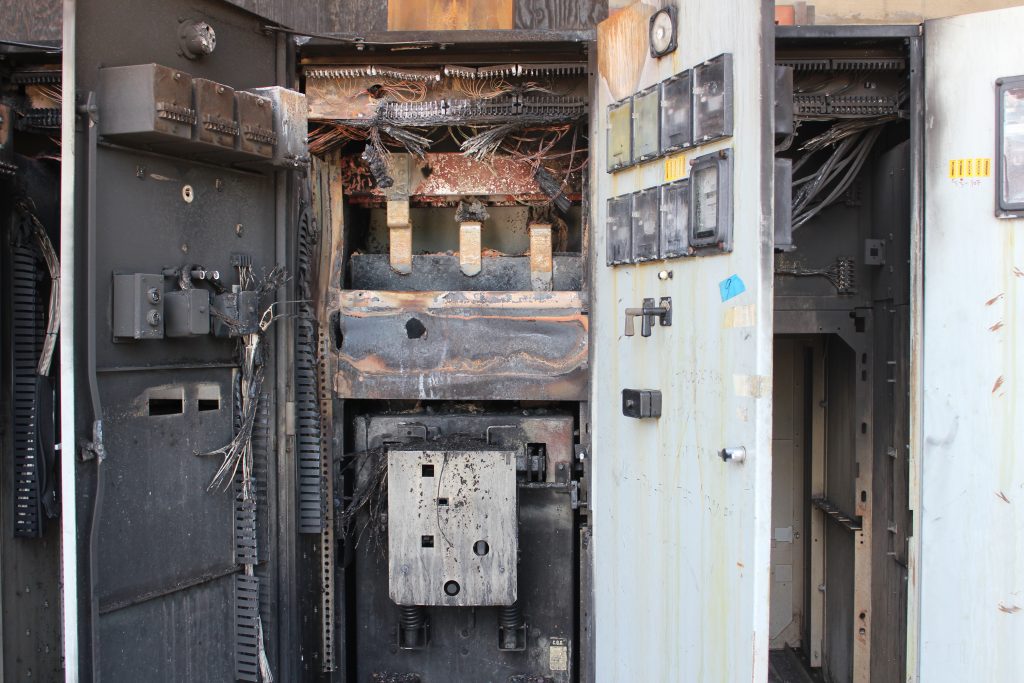
I was concerned we were going to burn the lab down. The lab was not prepared for such a fire. However after about 15 minutes of controlled chaos, the fire was finally extinguished. How? The old-fashioned way. A garden hose. Fortunately, the equipment had already tripped offline and been electrically isolated, so there was no electrical hazard during the firefighting.
A side story: I was discussing this event recently with a person at a conference. When I got to the description of the fire and fear of burning down the lab, his face lit up and exclaimed; “So you’re the one!!” What? He said he was just at this lab and someone there was telling the story of a person that came close to burning the lab down. OK, I guess that is my claim to fame.
But the test DID prove something important. HEAF events can release enormous energy in milliseconds and may eject hot gases, molten metal, and debris that ignite nearby combustible materials.
The Onagawa switchgear fire became a major case study for the nuclear industry. It demonstrated that arc-flash-driven HEAF events can cause fires and mechanical damage extending well beyond the equipment enclosure, which led to new international research programs and regulatory attention focused on understanding and mitigating these hazards.
The 2011 earthquake taught us many lessons. One of them was something few people expected: A seismic event may trigger a high-energy arc fault inside electrical equipment, which can then ignite a fire. That realization helped drive new research, testing programs, and safety improvements across the nuclear and industrial electrical world. And it all started with one photo of bent bus bars.
To learn more about IEEE 1584, Arc Flash Studies and Medium Voltage Power Systems, check out a few of Jim Phillips’ Scheduled and On Demand training programs below.
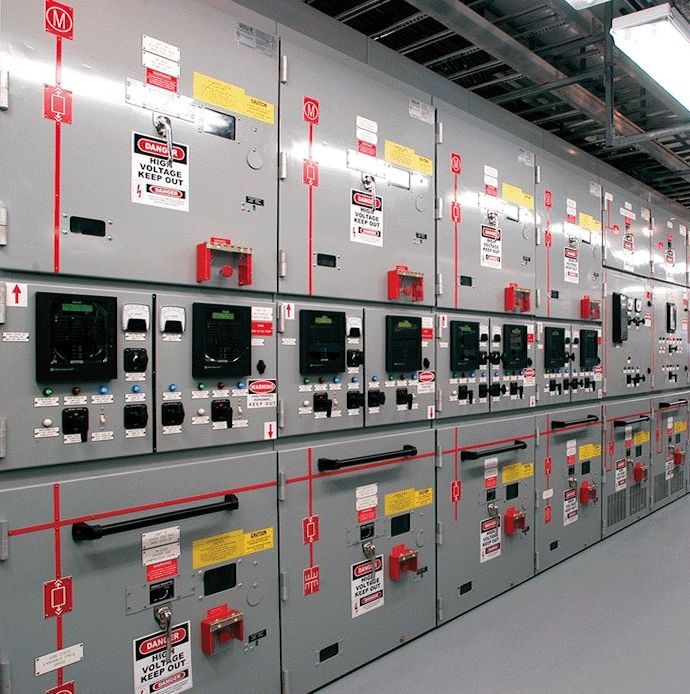
With a career beginning in 1981 and Brainfiller launching in 1987, Jim has built a global reputation as a trusted leader in electrical safety.
He currently:
💡 Did you know? Many NFPA 70E and Arc Flash trainers learn the material by attending Jim’s classes—while Jim is involved directly with the standards they teach.


Brainfiller offers several courses designed and taught by Jim, all targeted to engineers, electricians, and safety professionals.
NFPA 70E Qualified Worker Training (8 hours)
Covers risk assessment, PPE, LOTO, establishing an electrically safe work condition, and auditing requirements.
How to Perform an Arc-Flash Study | IEEE 1584 (16 hours)
Modeling, arcing current, incident energy, arc-flash boundaries, and system-level mitigation.
Fundamentals of Electrical Safety (2 hours)
Shock hazards, arc-flash basics, and the building blocks behind NFPA 70E.
DC Electrical Safety Fundamentals (2 hours)
Key safety practices for data centers and DC systems.
All training is available live, on-site, or on-demand, and includes completion certificates with CEU/PDH documentation.

| Cookie | Duration | Description |
|---|---|---|
| cookielawinfo-checbox-analytics | 11 months | This cookie is set by GDPR Cookie Consent plugin. The cookie is used to store the user consent for the cookies in the category "Analytics". |
| cookielawinfo-checbox-functional | 11 months | The cookie is set by GDPR cookie consent to record the user consent for the cookies in the category "Functional". |
| cookielawinfo-checbox-others | 11 months | This cookie is set by GDPR Cookie Consent plugin. The cookie is used to store the user consent for the cookies in the category "Other. |
| cookielawinfo-checkbox-necessary | 11 months | This cookie is set by GDPR Cookie Consent plugin. The cookies is used to store the user consent for the cookies in the category "Necessary". |
| cookielawinfo-checkbox-performance | 11 months | This cookie is set by GDPR Cookie Consent plugin. The cookie is used to store the user consent for the cookies in the category "Performance". |
| viewed_cookie_policy | 11 months | The cookie is set by the GDPR Cookie Consent plugin and is used to store whether or not user has consented to the use of cookies. It does not store any personal data. |