English
  Spanish

Question: Arc Flash Boundary – Safe?
Since NFPA 70E does not require arc-flash PPE outside of the arc-flash boundary, does that mean it’s a safe place to stand?
The Short Answer:
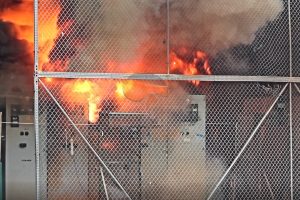
I would not stand there – without some protection! – Really? Yes, but I have the advantage of seeing many staged arc flash events in the lab so I know what it can do.
Let’s start with the basics.
NFPA 70E requires that an arc-flash boundary (AFB) be determined and as part of an arc-flash risk assessment (see NFPA 70E Article 130.5).
However, nowhere in NFPA 70E—and nowhere in IEEE 1584—does it say that:
That’s a common (and potentially dangerous) misconception.

The arc-flash boundary is defined as:
The distance from a prospective arc-flash source at which the incident energy equals 1.2 cal/cm².
That value—1.2 cal/cm²—is widely considered to be the approximate threshold for the onset of a second-degree burn on unprotected skin.
And that’s it.
The arc-flash boundary:
It’s simply a calculated distance tied to a thermal injury threshold.
Even if the incident energy is below 1.2 cal/cm², several serious hazards still exist:
NFPA 70E focuses heavily on thermal injury, but arc-flash events are far more complex than heat alone.
Standing just outside the arc-flash boundary does not protect you from:
None of those are addressed by the 1.2 cal/cm² line in the sand.
One of the biggest issues I see in the field is people treating the arc-flash boundary like a magic force field from a science fiction movie.
It’s not!
Arc-flash calculations—whether performed using IEEE 1584 or another method—are still models, not guarantees. Small changes such as:
can significantly change the actual exposure during an event.
Splitting hairs over inches or feet is a losing strategy.
The intent of NFPA 70E is risk reduction and preferably – elimination, not mathematical loopholes.
Unless you are properly trained, qualified, part of the work team and properly protected, then you have no business being in the area—boundary or not.
Here’s the rule of thumb I’ve always used and taught:
If you’re not wearing properly rated arc-flash PPE, leave the area.
Don’t argue about whether you’re:
If an arc flash occurs, you won’t care what the calculation said.
The arc-flash boundary is a planning tool, not a permission slip.
Don’t stand there.
Don’t test the math.
Don’t assume “outside” means “safe.”
💡 Did you know? Many NFPA 70E trainers learn the material by attending Jim’s classes—while Jim is involved directly with the standards they teach.


Jim’s background spans:
This progression gives Jim a rare, 360-degree view of electrical hazards—from theoretical models to real-world failures. His training incorporates both the engineering and the practical side of electrical safety.
Jim has played a major role in shaping the methodology behind modern arc-flash hazard calculations—the backbone of NFPA 70E’s incident energy analysis and PPE selection.
His instruction includes:

Brainfiller offers several courses designed and taught by Jim, all targeted to engineers, electricians, and safety professionals.
NFPA 70E Qualified Worker Training (8 hours)
Covers risk assessment, PPE, LOTO, establishing an electrically safe work condition, and auditing requirements.
How to Perform an Arc-Flash Study | IEEE 1584 (16 hours)
Modeling, arcing current, incident energy, arc-flash boundaries, and system-level mitigation.
Fundamentals of Electrical Safety (2 hours)
Shock hazards, arc-flash basics, and the building blocks behind NFPA 70E.
DC Electrical Safety Fundamentals (2 hours)
Key safety practices for data centers and DC systems.
All training is available live, on-site, or on-demand, and includes completion certificates with CEU/PDH documentation.
Train with Jim Phillips through Brainfiller.
Empower your team, strengthen compliance, and protect lives with industry-leading NFPA 70E and arc-flash training.


| Cookie | Duration | Description |
|---|---|---|
| cookielawinfo-checbox-analytics | 11 months | This cookie is set by GDPR Cookie Consent plugin. The cookie is used to store the user consent for the cookies in the category "Analytics". |
| cookielawinfo-checbox-functional | 11 months | The cookie is set by GDPR cookie consent to record the user consent for the cookies in the category "Functional". |
| cookielawinfo-checbox-others | 11 months | This cookie is set by GDPR Cookie Consent plugin. The cookie is used to store the user consent for the cookies in the category "Other. |
| cookielawinfo-checkbox-necessary | 11 months | This cookie is set by GDPR Cookie Consent plugin. The cookies is used to store the user consent for the cookies in the category "Necessary". |
| cookielawinfo-checkbox-performance | 11 months | This cookie is set by GDPR Cookie Consent plugin. The cookie is used to store the user consent for the cookies in the category "Performance". |
| viewed_cookie_policy | 11 months | The cookie is set by the GDPR Cookie Consent plugin and is used to store whether or not user has consented to the use of cookies. It does not store any personal data. |