English
  Spanish

IEEE 1584, NFPA 70E and the “2-Second Arc Duration” Myth
Question:
I’ve heard that an arc flash can’t last longer than two seconds. Is that true?
Short answer:
No! An arc flash can absolutely last longer than two seconds. Neither IEEE 1584 nor NFPA 70E says an arc flash is physically limited to two seconds. The two-second value is an assumption used for exposure time, not a limit on how long an arc can actually exist.
This misunderstanding comes from a statement in IEEE 1584-2018, which says that “2 seconds usually is a reasonable assumption for the arc duration.” That sentence gets quoted a lot, but it’s often taken out of context.
What IEEE 1584 is really addressing is how long to assume a worker is exposed to the arc, not how long the arc itself can physically exist.
In an arc-flash study, arc duration is normally based on protective device clearing time—how long it takes a breaker, relay, or fuse to detect the fault and open the circuit. In some systems, especially where protective devices are slow or coordination is poor, that clearing time can exceed two seconds.
IEEE 1584 permits the arc duration to be capped at 2 seconds for calculation purposes only when it is reasonable to assume that a person can move out of the arc-flash exposure area. In other words:
Two seconds represents human reaction and escape time, not a physical limit on arc duration. If there is a “boom”, we go into the fight or flight response and in this case, flight is the normal response, jumping out of the way.
The actual arc duration is generally unpredictable and is a function of many factors such as arcing current, electrode gap, voltage and much more. That is why the protective device clearing time is used – a known value.
In real-world conditions, an arc flash can potentially last:
This is especially true in systems with:
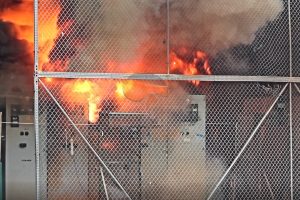
You don’t have to dig very deep on YouTube to see videos of some very long duration arc flash events.
That’s why it’s incorrect—and dangerous—to think of two seconds as a hard limit.
NFPA 70E also references the two-second arc duration assumption in specific locations.
As an example, NFPA 70E Table 130.7(C)(15)(b), which provides arc-flash PPE categories for dc systems.
Informational Note 2 to this table states that a two-second arc duration is assumed if there is no overcurrent protective device to limit the duration of the arc.
This language is often misunderstood. It does not mean:
What it means is that, for PPE category guidance, NFPA 70E assumes a two-second exposure duration when no overcurrent protective device exists to clear the fault. Often dc systems involve battery systems such as in uninterruptable power supplies (UPS) which often will not have overcurrent protection –
Caution! – technical humor follows. I’m sure this lack of protection has something to do with the “U” in the title – Uninterruptable.
NFPA 70E’s two-second assumption in Table 130.7(C)(15)(b) is a conservative exposure assumption, not a statement about arc behavior. Similar to ac arcs, a dc arc can potentially continue well beyond two seconds.
The 2-second cap should only be used when it is realistic that a worker could recognize the event and physically move away.
Examples where the 2-second assumption may be reasonable:
Examples where it may not be reasonable:
If a worker cannot reasonably move away, then the actual protective device clearing time should be used, even if it exceeds two seconds.
The 2-second value in IEEE 1584:
It is a calculation assumption based on human response, and it should only be applied when justified. Used correctly, it helps prevent unrealistic incident energy values. Used incorrectly, it can significantly underestimate arc-flash hazard
With a career beginning in 1981 and Brainfiller launching in 1987, Jim has built a global reputation as a trusted leader in electrical safety.
He currently:
💡 Did you know? Many NFPA 70E trainers learn the material by attending Jim’s classes—while Jim is involved directly with the standards they teach.


Brainfiller offers several courses designed and taught by Jim, all targeted to engineers, electricians, and safety professionals.
NFPA 70E Qualified Worker Training (8 hours)
Covers risk assessment, PPE, LOTO, establishing an electrically safe work condition, and auditing requirements.
How to Perform an Arc-Flash Study | IEEE 1584 (16 hours)
Modeling, arcing current, incident energy, arc-flash boundaries, and system-level mitigation.
Fundamentals of Electrical Safety (2 hours)
Shock hazards, arc-flash basics, and the building blocks behind NFPA 70E.
DC Electrical Safety Fundamentals (2 hours)
Key safety practices for data centers and DC systems.
All training is available live, on-site, or on-demand, and includes completion certificates with CEU/PDH documentation.
Organizations that adopt Jim’s training consistently report:
Recent recognition includes:


Because Jim is embedded in NFPA, IEEE, IEC, and NEC committees, he sees emerging trends before they appear in the codebook.
His training materials are updated immediately after each standards cycle, keeping teams aligned with NFPA 70E, IEEE 1584, and OSHA expectations.
🔧 From code to craft: Jim explains why requirements exist and how to apply them correctly in real electrical systems.
Partnering with Jim Phillips ensures your team learns NFPA 70E and arc-flash safety from someone who has helped guide the direction of the standard—not from copied material.
Train with Jim Phillips through Brainfiller.
Empower your team, strengthen compliance, and protect lives with industry-leading NFPA 70E and arc-flash training.


| Cookie | Duration | Description |
|---|---|---|
| cookielawinfo-checbox-analytics | 11 months | This cookie is set by GDPR Cookie Consent plugin. The cookie is used to store the user consent for the cookies in the category "Analytics". |
| cookielawinfo-checbox-functional | 11 months | The cookie is set by GDPR cookie consent to record the user consent for the cookies in the category "Functional". |
| cookielawinfo-checbox-others | 11 months | This cookie is set by GDPR Cookie Consent plugin. The cookie is used to store the user consent for the cookies in the category "Other. |
| cookielawinfo-checkbox-necessary | 11 months | This cookie is set by GDPR Cookie Consent plugin. The cookies is used to store the user consent for the cookies in the category "Necessary". |
| cookielawinfo-checkbox-performance | 11 months | This cookie is set by GDPR Cookie Consent plugin. The cookie is used to store the user consent for the cookies in the category "Performance". |
| viewed_cookie_policy | 11 months | The cookie is set by the GDPR Cookie Consent plugin and is used to store whether or not user has consented to the use of cookies. It does not store any personal data. |